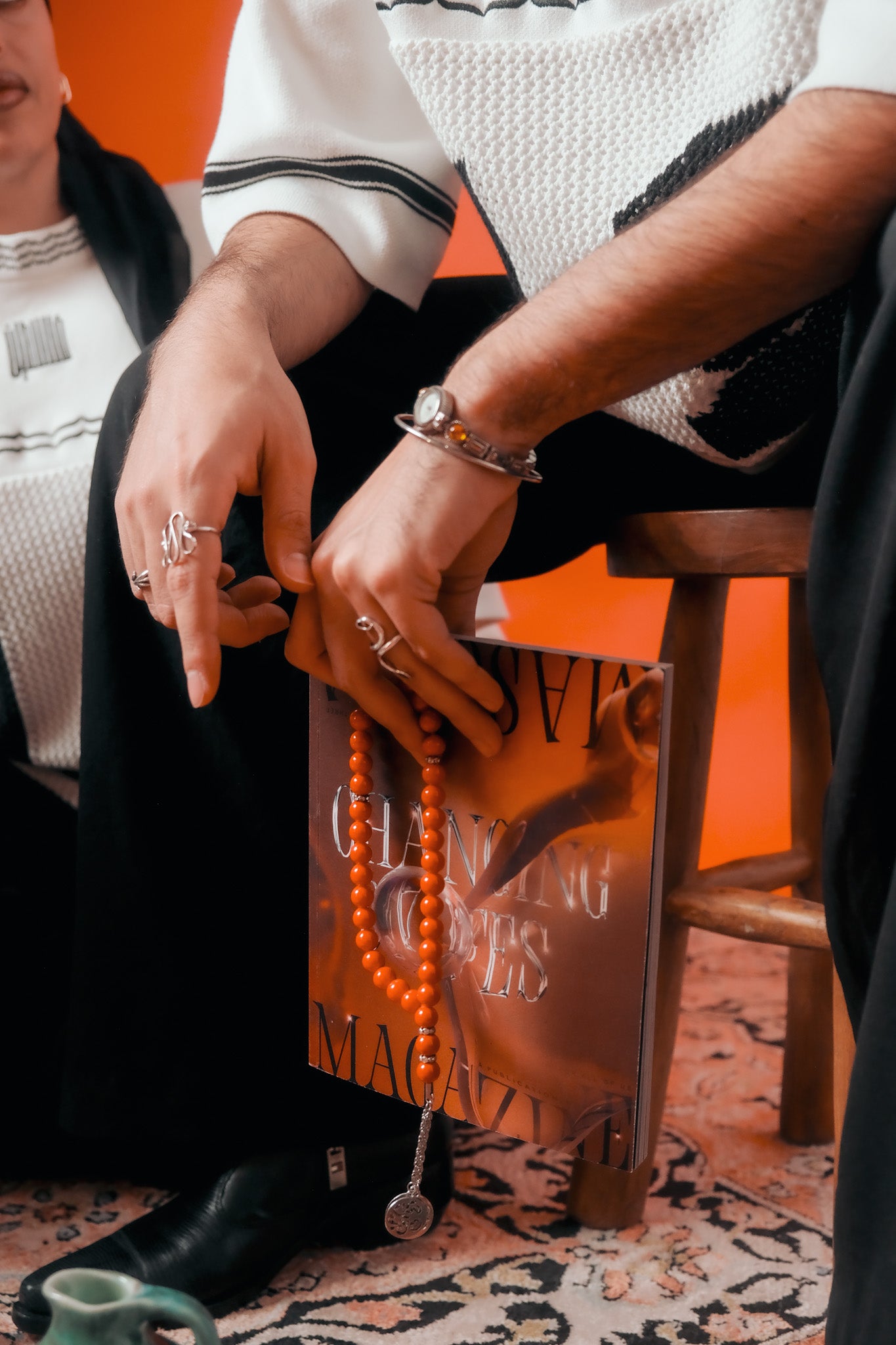

The Mohair Keffiyeh Cardigan: What Happens When Heritage Learns to Whisper
The keffiyeh has always known how to speak.
For a century it has been the loudest quiet garment in the world — a square of cotton that says everything without a single word printed on it. It speaks in stadiums and airports, in old photographs and new ones. It carries its message in a bold, unmistakable voice.
We wanted to see if it could whisper.
That question — can heritage speak softly and lose nothing? — is where the Mohair Keffiyeh Cardigan began. This is the story of how it was made, why it was made this way, and what we learned about the pattern by rebuilding it stitch by stitch in a completely new material.
The Problem with Printing
Here's an uncomfortable truth about most keffiyeh-inspired fashion: it's printed.
A print is a photograph of a pattern. It sits on top of the fabric the way a poster sits on a wall — decoration applied after the fact. And for a motif like the keffiyeh, whose entire identity comes from weaving — from the fishnet structure, the interlocking geometry, the discipline of the loom — printing it is a quiet contradiction. You end up with a picture of craftsmanship instead of craftsmanship.
At KADENCCI®, we made a rule early on: if the pattern was born in the weave, it stays in the weave. Our Keffiyeh Knit Jersey followed that rule first, translating the motifs into knit construction. The cardigan pushes the same principle further — into softer territory, heavier gauge, and a material the keffiyeh had never met before.
Why Mohair?
Mohair is one of the oldest luxury fibers on earth — shorn from the Angora goat, prized for millennia for a combination most fibers can't manage: it's warm without weight, strong without stiffness, and it carries a soft halo, that faint cloud of fiber that makes mohair knits look like they're glowing slightly at the edges.
But we didn't choose it for the résumé. We chose it for what it does to the pattern.
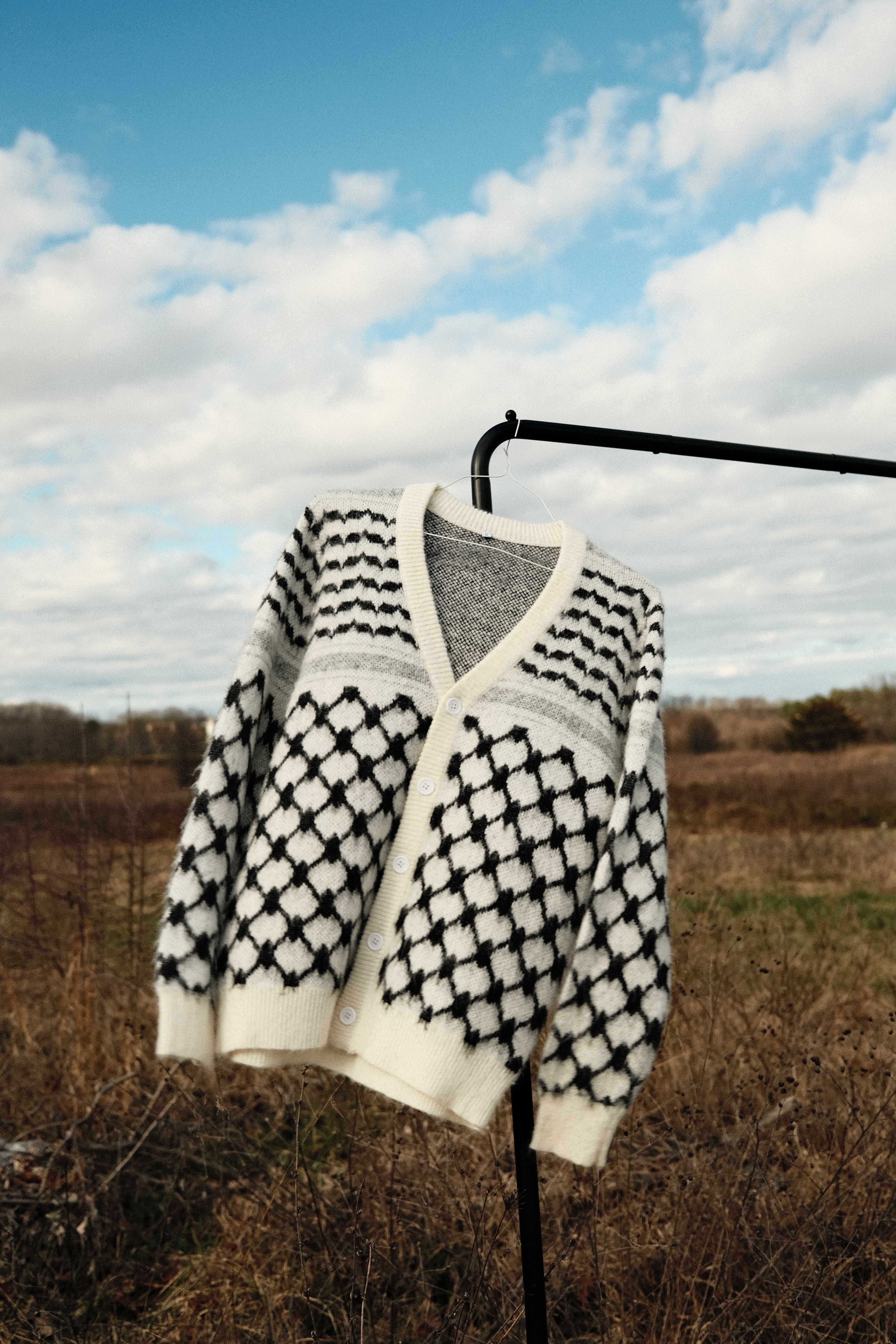
Render the keffiyeh's geometry in crisp cotton and it reads the way it always has — sharp, graphic, declarative. Render it in mohair and something unexpected happens: the halo softens every line. The fishnet blurs at its edges like a memory. The motifs are all still there — every one of them, structurally knitted, not printed — but they've dropped their voice. The pattern stops announcing and starts murmuring.
That felt right to us. Because heritage isn't only carried in declarations. It's also carried in the soft things — a grandmother's shawl, a blanket from home, the sweater someone left behind that still smells like them. Mohair let us move the keffiyeh from the first category into the second without losing a thread of its meaning.
Black and White, On Purpose
The cardigan comes in one colorway: the classic black and white.
We had options. We sketched others. And we kept returning to the same conclusion — for this piece, the original palette isn't a limitation, it's the point. Black and white is the keffiyeh's mother tongue. It's the version photographed on farmers in the 1930s, the version folded in a million cupboards across the diaspora, the version your eye recognizes from across a street before your brain has finished the thought.
Cultural minimalism — the design philosophy this brand is built on — means knowing when not to add. A second colorway would have been a product decision. One colorway is a design conviction: this is the pattern as it has always been, in a form it has never taken.
Reading the Cardigan
Look closely at the knit and you're reading the same archive we described in our keffiyeh history post — the motifs that turn this pattern into a document:
The fishnet weave, tied to the Mediterranean and the fishermen who worked it — livelihood, sustenance, the sea.
The bold lines, echoing the ancient trade routes that made the region a crossroads of the world.
The olive leaves, the deepest symbol of them all — the tree that outlives empires, the patience of people who plant for grandchildren they'll never meet, the living emblem of sumud, the steadfastness we named our slogan for.
On a scarf, these motifs are read at a glance. On the cardigan, they're read slowly — over months of wearing, in mirrors and reflections, by the friend sitting across from you who finally asks, "wait, is that…?" Yes. It is. And now you have a story to tell.
Craft as a Form of Respect
There's a version of this product that would have been faster and cheaper to make. Print the pattern on a blended knit, ship it in six colorways, ride the trend. We know that version exists because we've watched other brands make it.
We believe how you make something is part of what it means. So the cardigan follows the same non-negotiables as everything we produce:
Knitted, not printed. The pattern lives in the construction itself, honoring the woven origins of the keffiyeh. If you unraveled the cardigan — please don't — the motifs would come apart with the garment, because they are the garment.
Ethically sourced, start to finish. A piece that honors a people's dignity cannot be made by diminishing anyone else's. We know our supply chain, and we're accountable for it.
Meals with every purchase. Our philanthropy model is stitched into the business permanently: every cardigan sold provides meals to those in need. The keffiyeh began as the garment of people who fed others — farmers, fishermen, shepherds. A piece bearing its pattern should keep feeding people. It's the least literal-minded tribute we could think of, and our favorite one.
The Whisper, Answered
So — can heritage speak softly and lose nothing?
After living with this cardigan, our answer is: it can do something better. It can speak intimately. The scarf addresses a crowd; the cardigan addresses whoever is close enough to notice. It turns the pattern from a public statement into a personal one — heritage worn not as a banner but as a second skin, warm against the cold, present on the ordinary days when nobody's watching and meaning matters most.
The keffiyeh spent a hundred years proving it could endure anything — commodification, imitation, every attempt to empty it out. The Mohair Keffiyeh Cardigan is our small addition to that long story: proof that the pattern can also evolve, soften, and settle into new forms without surrendering an inch of what it means.
The olive trees learned that trick a thousand years ago. Bend, adapt, remain.
For the Steadfast.